
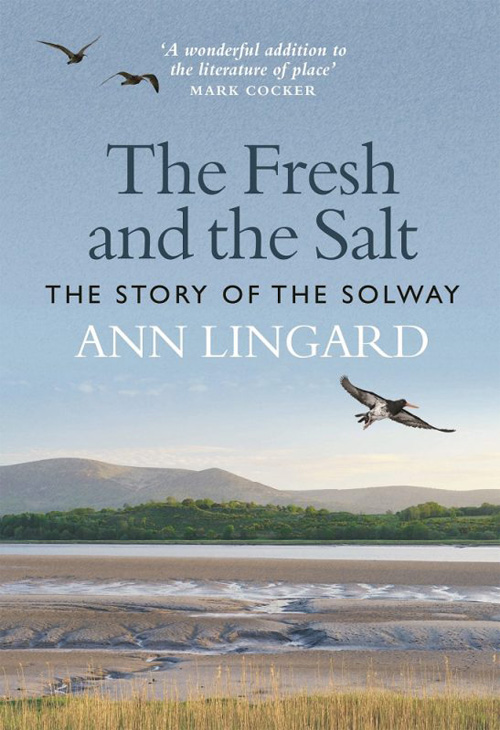
The Fresh and the Salt is a story of the Solway Firth and its origins and ever-changing margins. It’s a story that has influenced other stories, of the lives of non-humans – animals and plants and micro-organisms – and humans, that occupy the edges. The perspective ranges from satellite views to the microscopic, even the molecular. Sometimes I have been actively involved with the Firth – wading across it, slithering along its mudflats, walking far out to mussel-beds on a low Spring tide, flying over it, bouncing over its waves in boats, rowing in a skiff – and many times I have also been an observer and listener. There is much more about the book (including more photos, and videos) on the dedicated website www.thefreshandthesalt.co.uk – where you can also find out about, and book, my low-tide guided shorewalks.
‘Like a hungry gull, Ann Lingard explores her beloved Solway shoreline for every living detail that catches her eye, from its tiny mudshrimps to the shape of its tidal silts. She lets no detail escape her notice and in so doing has created a portrait of this nation-cleaving water that is as broad and deep as the estuary itself. A wonderful addition to the literature of place.’ – MARK COCKER, author and naturalist
‘Beautiful, intensely visual prose, born from deep intimacy with subtle borderlands: land and sea, England and Scotland, people and environments. Lingard expertly probes the margins for their hidden riches’. – DAVID GANGE, author of The Frayed Atlantic Edge
‘Absolutely wonderful … a wonderful feeling for the place, the weather, the monks and mudflats and marshes… Every chapter is full of people, all with different expertise and personalities.’ – JENNY UGLOW, author and biographer
‘Catching the poetic in the scientific, and steeped in environmental histories of the area, Ann addresses saltmarsh and mudflat, song and painting, mudshrimp and stonemason with the same curiosity. From the Newton Arlosh saltmarshes via saltworks and wildfowling, to the wetlands of Caerlaverock, this is a kaleidoscopic portrait of the borders of the land.’ – WILL SMITH, Cumbria Life Magazine, September 2020
‘… riveting prose. This is deep and beautiful natural history writing rather than nature writing.’ – FERGUS COLLINS, Editor, Countryfile magazine.
‘You can sense Ann’s unwavering dedication and interest … refusing to stop with the knowledge she already holds, and seeking out those with additional stories and information to add. She never fails to make the reader feel as if they are right alongside her (knee deep in mud at times) exploring all the same locations. There is truly something for everyone [here] …’ – Tidelines, Winter 2020 (p22)
‘…a natural history in the richest sense of the term. … Lingard’s arresting language isn’t there simply to inform. It is an invitation to settle down, accommodate, and inhabit a particular setting. … I admire the clarity that Lingard brings to the relationships between creatures and places, people and places, and indeed to the relationship between one place and another. It takes a certain delicacy of language to tease this out.’ – from PROFESSOR ISAAC LAND’S long and thoughtful review in The Coastal History Blog 52 (sadly no longer available online)
‘The book is a cabinet of curiosities, an engaging portrait not only of place but of a particular way of seeing; one that sets out to investigate and celebrate much more than that which lies merely upon the surface.’ – KAREN LLOYD in Caught by the River, February 2021.
The book’s ‘scope is so broad, the writing so all-encompassing that, I found it necessary to put it to one side so as to return afresh, as one might a collection of short stories. However, its comprehensive quality and informed view mean that the book will serve, not just as a book about Solway, but also as an exemplar for readers’ experience of their own estuary ecosystem, serving to direct attention to diverse aspects of ecological relations of the whole.’ – PETER REASON, January 2021, in Shiny New Books.